
exhibition photography act two: Cleo Wächter
On Mourning and Radical Rural Relations
hn. Lyonga & Lene Markusen for Field Narratives
as part of the group exhibition
"This, too, is a way of keeping each other close"
at Bärenzwinger Berlin, May 29 – August 10, 2025
curated by Maxime Lübke & Annika Reketat
act one
hn. lyonga
How We Sit in Our Mother's Gardens, 2025
an audio essay & 2 lullabies, a kerosine lamp, a gallon of water, and a cup
our mother's gardens are not sites for excavation
or taking
in our mothers' gardens,
everything is one
all blood is one.
the past, present, and future
are one - hn. lyonga
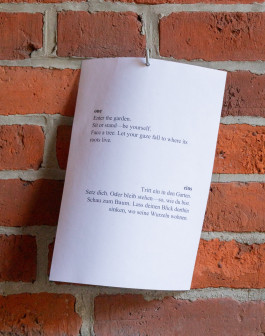
“How We Sit in Our Mother’s Gardens” draws inspiration from Alice Walker’s seminal Womanist Prose In Search of Our Mothers’ Gardens. It asks: what becomes of the garden once we have found it? What condition do we find it in? Is the woman who once lived and tended it still present? What remains - a grave (marked or unmarked), a flourishing space of Jasmin, or a tangle of thorns? Do we mourn there? Do we pour libations, offer remembrance, assume responsibility? What is our obligation to our mothers’ gardens - to her memory, to her labor, to her life?
These gardens are at once literal and speculative spaces - ecologies in which various forms of life coexist in layered, interdependent relation. Our grandmothers, mothers, sisters, and aunts dwell here. These are sites of burial and of gathering - places for ritual, for prayer, for grief. Yet they are also sites of emergence, where new paths are forged, and where latent futures begin to stir.
exhibition photography act one: Wataru Murakami
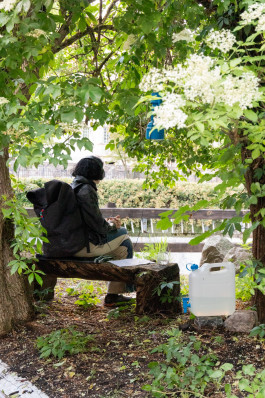
Assembling all these memory fragments of and about my mother, grandmother, and great-grandmother is a gathering of “the historical and psychological threads of the life my ancestors lived.” In the writing and assembly of this work, “I felt joy and strength and my own continuity” (Alice Walker in In Search of Our Mothers’ Gardens).
For my mother (hardeson lolita), my grandmother (Mary Mojoko), and the women whose names are buried in their Gardens - you planted and sowed these seeds. & I am still learning how to sit with them.
This work draws from the traditions of the Bakweri people of southwest Cameroon and the lived experiences of women in my family.
It consists of four elements: an audio essay & 2 lullabies, a kerosene lamp, a gallon of water, and a cup. Together, they constitute a mourning space - an offering within the garden.
written and read by hn. lyonga
singing by hardeson lolita
duration: 09:58
sound dramaturgy: Markus Posse
Lene Markusen
Props for Rituals of Mourning, 2025
Who can hold this sorrow but me?
Created out of (both personal and shared) experiences of missing sites and rites for mourning in contemporary life in Germany, Lene Markusen´s Props for Rituals of Mourning aims to provide a moment and a site for both individual and collective mourning.
In the site specific installation Lene Markusen has placed four wooden sheets, colored purple with pigment and lacquered at different sites in the garden. The props refer to the video performance, an excerpt of her recent video work Travelling Hands: Somatics of Female Migrant Labor in and around Hamburg (Denmark/Germany/Italy, 2025, 20 min.). Here the four female* performers Lucrezia Palandri, Erica Cosi, Monica Hirano and Alessia Mallardo connect to their grief about the people they had to leave due to labour at a distant site – in interaction with similar purple sheets, displaying photographers of the persons, who have been left and are missing. At the Bärenzwinger the Props are arranged across the garden in various constellations; respectively laying on the ground, leaned against a wall or placed at a dead tree; a vascular plant in a different state of being, which once will transform into life again.
For the visitors, these Props might become imaginary displays, serving to evoke memories and emotions connected to losses, provide a moment of protection in their body-related size, and being objects to hold and handle. In color, visually highlighted and in number various, Props for Rituals of Mourning suggests breaking the silences and solitudes around grief – as a collective ritual across the garden.

"Travelling Hands: Somatics of Female
Migrant Labor in and around Hamburg",
(installation view, video: Andreas Doepke)
exhibition photography
act two: Cleo Wächter
On Mourning and Radical Rural Relations
hn. Lyonga & Lene Markusen
for Field Narratives
as part of the group exhibition
"This, too, is a way of keeping each other close"
at Bärenzwinger Berlin
May 29 – August 10, 2025
curated by Maxime Lübke & Annika Reketat
act one
hn. lyonga
How We Sit in Our Mother's Gardens, 2025
an audio essay & 2 lullabies, a kerosine lamp, a gallon of water, and a cup
our mother's gardens are not sites for excavation
or taking
in our mothers' gardens,
everything is one
all blood is one.
the past, present, and future
are one - hn. lyonga
“How We Sit in Our Mother’s Gardens” draws inspiration from Alice Walker’s seminal Womanist Prose In Search of Our Mothers’ Gardens. It asks: what becomes of the garden once we have found it? What condition do we find it in? Is the woman who once lived and tended it still present? What remains - a grave (marked or unmarked), a flourishing space of Jasmin, or a tangle of thorns? Do we mourn there? Do we pour libations, offer remembrance, assume responsibility? What is our obligation to our mothers’ gardens - to her memory, to her labor, to her life?
These gardens are at once literal and speculative spaces - ecologies in which various forms of life coexist in layered, interdependent relation. Our grandmothers, mothers, sisters, and aunts dwell here. These are sites of burial and of gathering - places for ritual, for prayer, for grief. Yet they are also sites of emergence, where new paths are forged, and where latent futures begin to stir.
exhibition photography
act one: Wataru Murakami
Lene Markusen
Props for Rituals of Mourning, 2025
Who can hold this sorrow but me?
Created out of (both personal and shared) experiences of missing sites and rites for mourning in contemporary life in Germany, Lene Markusen´s Props for Rituals of Mourning aims to provide a moment and a site for both individual and collective mourning.
In the site specific installation Lene Markusen has placed four wooden sheets, colored purple with pigment and lacquered at different sites in the garden. The props refer to the video performance, an excerpt of her recent video work Travelling Hands: Somatics of Female Migrant Labor in and around Hamburg (Denmark/Germany/Italy, 2025, 20 min.). Here the four female* performers Lucrezia Palandri, Erica Cosi, Monica Hirano and Alessia Mallardo connect to their grief about the people they had to leave due to labour at a distant site – in interaction with similar purple sheets, displaying photographers of the persons, who have been left and are missing. At the Bärenzwinger the Props are arranged across the garden in various constellations; respectively laying on the ground, leaned against a wall or placed at a dead tree; a vascular plant in a different state of being, which once will transform into life again.
"Travelling Hands: Somatics of Female
Migrant Labor in and around Hamburg",
(installation view, video: Andreas Doepke)
For the visitors, these Props might become imaginary displays, serving to evoke memories and emotions connected to losses, provide a moment of protection in their body-related size, and being objects to hold and handle. In color, visually highlighted and in number various, Props for Rituals of Mourning suggests breaking the silences and solitudes around grief – as a collective ritual across the garden.